All the links to affiliates, ads etc on my blog generate income. I donate 100% of ALL income to various charities. So buy books using links on my blog - they cost you no more - but the affiliate fee I receive is donated to various charities (to see which charities visit http://messcharityrun.blogspot.com.au/)

Friday, 21 February 2014

Stella Award Longlist 2014 and the Society of Authors Translation Prizes


A couple of literary prize updates for you.

Stella Prize

The Stella Prize announced their 2014 Long List. The Stella Prize was awarded for the first time in 2013 and it is named after one of Australia’s iconic female authors, Stella Maria “Miles” Frankiln, it is for fiction and non-fiction books by female writers. The first prize is $50,000.


Longlist 2014

Letter to George Clooney – Debra Adelaide
Moving Among Strangers: Randolph Stow and My Family – Gabrielle Carey
Burial Rites – Hannah Kent
Night Games: Sex, Power and Sport – Anna Krien
Mullumbimby – Melissa Lucashenko
The Night Guest – Fiona McFarlane
Boy, Lost: A Family Memoir – Kristina Olsson
The Misogyny Factor – Anne Summers
Madeleine: A Life of Madeleine St. John – Helen Trinca
The Swan Book – Alexis Wright
The Forgotten Rebels of Eureka – Clare Wright
All the Birds, Singing – Evie Wyld
This list of twelve comes from over 160 entries. For more details on each of the books and the prize itself go to http://thestellaprize.com.au/the-stella-prize/2014-2/longlist-2014/


The Society of Authors Translation Prizes

On February 12 seven translators received prizes totalling more than 19,000 pounds at the Society of Authors Translation Prizes awards. The Winners of the Prizes are first named below with the work and author following.

The Saif Ghobash Banipal Prize (Arabic) – Joint Winners
William Maynard Hutchins – “A Land Without Jasmine” by Wajdi al-Ahdal
Jonathan Wright – “Azazeel” by Zoussef Ziedan

The Schlegel-Tieck Prize (German)
Ian Crockatt – “Pure Contradiction – selected poems” by Rainer Maria Rilke
Runner Up – James Bulloch – “Sea of Ink” by Richard Wiehe

The Scott Moncrieff Prize (French)
Beverley Bie Brahic – “The Little Auto” by Guillaume Apollinaire
Runner Up – Euan Cameron – “A Journey to Nowhere – Detours and Riddles in the Lands and History of Courland” by Jean-Paul Kauffman

The Premio Valle Inclan (Spanish)
Frank Wynne – “The Blue Hour” by Alonso Cueto
Runner Up – Nick Caistor and Lorenza Garcia – “Traveller of the Century” by Andres Neuman
Runner Up – Anne McLean – “The Sound of Things Falling” by Juan Gabriel Vasquez

The Vondel Prize (Dutch)
David Colmer – “The Misfortunates” by Dmitri Verhulst
Runner Up – Ina Rilke – “The Black Lake” by Hella S. Haasse

The Ria Domb/Porjes Prize (Hebrew)
Todd Hasak-Lowy – “Motti” by Asaf Schurr

For more details on the Przies, the Judges, publishers etc. go to http://www.societyofauthors.org/soa-news/winners-society-authors-translation-prizes


Tuesday, 18 February 2014

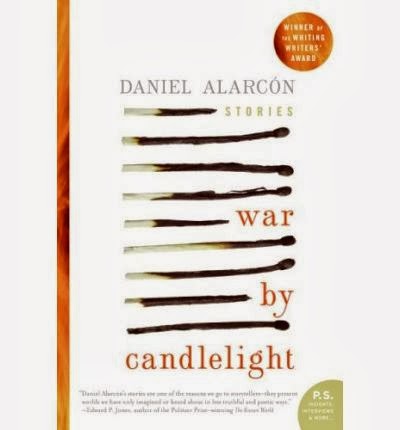
War By Candlelight - Daniel Alarcon

Before I landed on a Mario Vargas Llosa ‘s “Death In The Andes” as my book to represent Peru, I had already purchased “War By Candlelight” by Daniel Alarcon, a collection of his short stories. Once I learned that Alarcon had moved to the Untied States as a three year old I thought a better representation of the nation would be the Nobel Prize winner. But not to let a book go to waste I made my way through the his stories. My edition (published by Harper Perennial) contains a meaty section on the writer himself and although he left a troubled nation when only a small child, he did return to teach photography as a Fulbright Scholar and in his younger years did return each year for a visit. This collection of short stories all reflect on Peru so maybe I shouldn’t have been so hasty to make Mario Vargas Llosa my pin up boy for the month!!

This collection contains nine short stories.

First up we have “Flood” a tale of three youths who participate in a riot (after starting it by throwing a rock) in Lima during a downpour. The subsequent consequences of their actions and their visits to the local “university” (the jail) tell the story of a Capital in chaos. The city is divided by gangs, the jail by rebel forces and other criminals, the persecution as well as the disbelief that violence is not just a way of life. A simple story but one that reveals a melting pot of issues.

“City of Clowns” is also set in Lima where we have a journalist who has been assigned a “feature story” of following the city’s clowns. The people who make a meagre living whilst in disguise, the beggars who are dressed up to sell smiles, poetic words or mints. Our protagonist grew up as a single child with only his mother as support, on the wrong part of Lima, getting his life education (as well as his practical one) by being denigrated by his class mates. Another moral tale of a city in disguise, one that is not what it seems, a place of crime, extreme poverty and ignorance.

I worked and slept and worked, and thought as little as possible about my old man, my mother, Carmela. I thought about clowns. They had become, to my surprise, a kind of refuge. Once I started looking for them, I found them everywhere. They organized the city for me: buses, street corners, plazas. They suited my mood. Appropriating the absurd, embracing shame, they transformed it. Laugh at me. Humiliate me. And when you do, I’ve won. Lima was, in fact and in spirit, a city of clowns.

We then move to “3rd Avenue Suicide”, set in the USA our hero is a Peruvian immigrant who is living in sin with his young Indian girlfriend.  Here we have the clash of three cultures (indian, Peruvian and USA) and what is acceptable as an immigrant – and what parts of our culture we bring with us, or leave behind. We all carry shame….

“Lima, Peru, July 28, 1979” – this is their Independence Day. A shorter story telling the tale of a boy killing black stray dogs and hanging them in the streets, with painted slogans on their bodies, as part of the clandestine people’s uprising. His fate is sealed when he chases a particularly sleek black dog.

In 1970, a town disappeared beneath the Andes. An earthquake. Then a landslide. Not a village but a town. Yungay. It was a Sunday afternoon; my father and I listened to the World Cup live from Mexico City, Peru playing Argentina to a respectable draw, when the room shook vaguely. And then the news came slowly; filtered, like all things in Peru, from the provinces to Lima, and then back out again to all the far-flung corners of our make-believe nation. We were aware that something unspeakable had occurred, but could not name it just yet. The earth has spilled upon itself, an angry sea of mud and rock, drowning thousands. Only some of the children were spared. A travelling circus had set up camp at the higher end of the valley. There were clowns in colourful hats and children laughing as their parents were buried.

“Absence” is also set in the USA where we have a young Peruvian artist visiting New York for the opening of his solo exhibition. His original request for a 90 day visa was declined in Peru, his actual 30 day visa was reduced to 14 days when he arrived in the States and we listen to his depiration as he struggles with the limited time to assess a potential new homeland (he would of course become an illegal immigrant) and his struggle with the languages and the feeling of disconnection he now has with his violent paintings.

A very short story is “The visitor” where we have the survivors of a landslide in the Andes, burying their own and counting and retrieving the parachutes which conatin aid, before they are graced by a visitor.

The title story “War By Candlelight” is the story of Fernando, a revolutionary, told in non sequential date snippets. You piece together his story and his journey to revolution through his family tales, his experiences at university, at protests etc.

Don Jose, watching his son toast the houses he would build for Peru’s homeless, watching his son tremble with emotion at the warmth of the family surrounding him, recognized that Fernando’s heart was like his own; nostalgic but combative, caring but suspicious, able to bundle great ideas into intractable knots of personal anxiety. It is the way men begin to carry the world with them, the way they become responsible for it, not through their minds, but through their hearts. And though they shared much, the differences between Don Jose and his son were also striking, and also a question of heart. Don Jose and his son were also striking, and also a question of heart. Don Jose saw that as well and did not, as others did, attribute those differences to something as simple as youth.

“A science for being alone” is the story of  a destitute Peruvian who proposes to his “sweetheart” every year on their daughter’s birthday. The day of this story is her 5th birthday. Another story of pursued happiness, potential better times ahead, grand plans that are beyond reach.

Finally we have “A Strong Dead Man” – a sixteen year old is being taken by his older cousin to the park for a wlk on the day his father has had his third stroke. A reflective tale of  sanctity of life, relationships, memory and loss.

Overall this is a great collection of stories, each a subtle reflection on a theme but holistically all what it means to be Peruvian, as well as the standard existentialist themes. Every story is a small movement, starting off quietly before the large crescendo, all contributing to a masterful symphony. I really enjoyed all of these stories and again I’ve had another glimpse into Peru and the years of political struggle, the hardships, poverty, natural disasters and more. I’m glad I took the journey.


Monday, 17 February 2014

Death in the Andes - Mario Vargas Llosa (translated by Edith Grossman)

As part of my World Heritage Listed sites Literature Challenge the month of February saw me travelling (via non fiction) to Peru. Where else to chose your writer than from the Nobel Prize in Literature which Mario Vargas Llosa won in 2010. His citation for the award reads: "for his cartography of structures of power and his trenchant images of the individual's resistance, revolt, and defeat"

“Death in the Andes” was written in 1993 and follows a character (Lituma) from his 1987 work “Who Killed Palomino Molero?” Lituma is a civil guard and has been sent, in disgrace, to the town of Naccos. The majority of the inhabitants of this rural shanty town are building a highway. Each night Lituma tells his story to his superior, Tomasito, his tale of meeting and falling for a prostitute Mercedes, the reason why he is in disgrace. The nightly tales detail Lituma and Mercedes life on the run from the mob.

Add to this mix an albino travelling merchant who is searching for his only true love, a mute who lived in the hills with a herd and is at peace with nature and a Government official hiding under a false name from the rebels. All three of these men disappear from the village and the suspicion immediately lands on Dionisio, a past travelling carnival leader, and his wife Adriana, a suspected witch, who run the local cantina.

This is a novel of fine character portraits:

From the time he was a boy, they had called Pedrito Tinoco half-wit, moron, dummy, simpleton, and since his mouth always hung open, they called him flycatcher too. The names did not make him angry, because he never got angry at anything or anyone. And the people of Abancay never got angry with him either; sooner or later everybody was won over by his peaceful smile, his obliging nature, his simplicity.

The mystery of the missing men is the main plot of the novel with the love story told at night being the sub-plot. But within the whole mix we have tales of witchery, sorcery, spells, ancient Aztec rituals, the history of Peru and the Andes. Small snippets of the rebels appearing and killing innocents throughout the region, also crop up, adding a further tension to the citizens of Naccos.

‘The ancestral gods, the tutelary spirits of the hills and mountains in the Cordillera,’ replied the professor, delighted to speak about the thing he seemed to love best. ‘Evert peak in the Andes no matter how small, has its own protective god. When the Spaniards came and destroyed the idols and the burial grounds and baptized the Indians and prohibited pagan cults, the thought they had put an end to Idolatry. But in fact it still lives, mixed in with Christian ritual. The apus decide life and death in these regions. They’re the reason we’re here now, my friends. Let’s drink to the apus of La Esperanza!’

This is a novel filled with Peruvian ritual and beliefs and it gave me an amazing insight into a Nation I know little about. How a nation can be politically, dogmatically, racially and culturally be divided. Apus, the gods of the mountains, and the evil Pishtacos, the vampires of Andean folklore rule the mountains, they are the ones who take your children, your partners, they are the ones who cause earthquakes and avalanches, they are the ones who have taken the three missing men. This is a portrait of a nation on the brink, of revolutionary change, of extreme economic hardship.

Only decay, what we have nowadays, is given away for nothing. You men don’t have to pay anybody anything to live in uncertainty and fear, to be the wrecks you are. That’s free of charge. Work on the highway will stop and you won’t have jobs, the terrucos will come and there’ll be a slaughter, the huayco will come down and wipe us off the map. The evil spirits will come out of the mountains to celebrate, they’ll dance a farewell cacharpari to life, and so many condors will be circling overhead they’ll blot out the sky. Unless…

As you can see from the few excerpts above the book is littered with Peruvian slang and terms that I was not familiar with, however it didn’t take me very long to get used to it and understand quite a number of the references. One thing I did find slightly distracting was the night time discussions where Lituma was telling his story, including his conversations with Mercedes, only to be interrupted by Tomasito urging him on for more details. This did confuse me at times.

For me this was a great introduction to Peru’s history and cultures as well as the pagan beliefs and given the theme of my Literature Challenge was to learn more about the nations that feature a UNESCO World Heritage Listed Park, it has succeeded on a number of levels.


I’ll be back with a review of Daniel Alarcon’s “War By Candlelight” later this week, a collection of short stories by a young Peruvian writer.

Monday, 3 February 2014

The Birthday Buyer - Adolfo Garcia Ortega (Translated by Peter Bush)

In 1963 Primo Levi’s “La Tregua” (The Truce) was released, a follow up memoir to his “Se questo e un uomo” (If this Is Man), tales of his survival in Auschwitz. In “The Truce” two pages are dedicated to a 3 year old boy, Hurbinek, who died in Auschwitz in the room holding Levi, after the concentration camp was “liberated”.

50 years later (for the English translation) we have Adolfo Garcia Ortega, obsessed by that three year old boy. To such an extent that he decides to rescue his story from oblivion, as there are so many stories of oblivion from the holocaust, and imagine his tale.

Last year I reviewed Laurent Binet’s “HHhH” a WW2 story also, one that covers the assassination attempt on Reinhard Heydrich, but this novel was also Binet’s story, his struggle of writing true “historical fiction”. “The Birthday Buyer” is also our novelist’s story but here we don’t have the struggle with “inventing” historical fiction, we actually have an unashamed invention, a fantasy of Hurbinek, a homage to a life not lived.

Children, especially if they are very young, leave barely a trace. They don’t write letters, leave written or oral accounts in their wake, don’t draw up documents, contracts, receipts, don’t own valuable objects, aren’t remembered by their community because of any common gesture or action, have few friends, and the ones they do have are other children. They live cheek-by-jowel with their families, their parents, the brothers and sisters, the photos in which they appear are family photos, where it is almost impossible to identify even the adults. And if the adults disappear with them, no one, ever, will call them to mind in even the most fleeting of reflections.

This is a gruesome book, one where our writer researches the horrors of the holocaust and details time after time the brutal treatment of the Jews, primarily the children. He owes this research to Hurbinek, he needs to clean away the sins of the past. To fulfil this wish, this dedication, he decides to travel to Auschwitz to see the resting place of this child, the place detailed by Levi. But on the way he is involved in a car accident and is holed up in a German hospital, where the experiments on him become hallucinations and recriminations of what happened in the concentration camps.

And I have just woken up from a similar dream in the hospital in Frankfurt:  in my dream I was on top of a mountain of rubbish and filth. I couldn’t identify the kind of rubbish, but I knew, as a matter of course, that it was foul-smelling; there were old clothes, scrap metal and even human remains that I accepted, as a matter of course. Next to me, at the top of the mountain, someone had nailed up a sign: FRANKFURT. From where I stood, I could see two other mountains, also containing all manner of filth and rubbish. The sign on one said AUSCHWITZ and on the other WARSAW.

This is a very very difficult novel to read, the ongoing descriptions of atrocities; the linking of Hurbinek’s imagined life to the lives of successful people in the arts, labourers or simple family men. The life not lived. But it doesn’t end there, Levi in “The Truce” knew nothing of Hurbinek’s past, was he born in Auschwitz, was he a victim of Mengele’s experiments, was he born deformed and brought here but somehow escaped the gas chambers? All these questions about a deformed child who could not speak are imagined by Adolfo Garcia Ortega. So we have an imagined past.

Although the novel contains quite a lot of repetitive material, for example "I learned...., I learned...." the listing of the atrocities is so moving and relevant to the recovery of history that it doesn't become distracting. We even have sections that simply lists words to describe the horrors, but all within context, how do you come up with a "word" to describe what occurred.

Every so often you come across a novel which stuns you, one that makes you stand up and celebrate literature, one that you want to tell everybody they should read. This is one of those books, a novel that has haunted me since its completion and one that will haunt me for a while to come (I’m sure). As a newbie to the world of “translated fiction” (I’ve only read the shortlist for the Independent Foreign Fiction Prize for the last two years), I may be out of my depth in calling for this to be a certainty for the 2014 shortlist, but in the translated novels I’ve read in the last year, this one is a standout. May more people come across its riches now that it is available in English.

Thanks to Hispabooks for yet another independent publisher who focuses on translated works, this time from the Spanish. For more details of their offerings go to http://www.hispabooks.com/